 DTRAC
DTRAC is an Android system for research data collection. It brings together smartphone sensors, health records, and participant responses. Each study can configure its collection items, questions, and schedules, with local storage and server synchronization.
What can you collect?
| Participant activities | Smartphone sensors | Health records |
|---|---|---|
| Surveys and EMA, voice responses, cognitive games | Motion, location, screen and battery, network and call state | Sleep, exercise, heart rate and other records held by a provider |
Participant activities and device records can be used together. Available data depends on the study configuration, permissions, device, and records in the source app.
How does data flow?
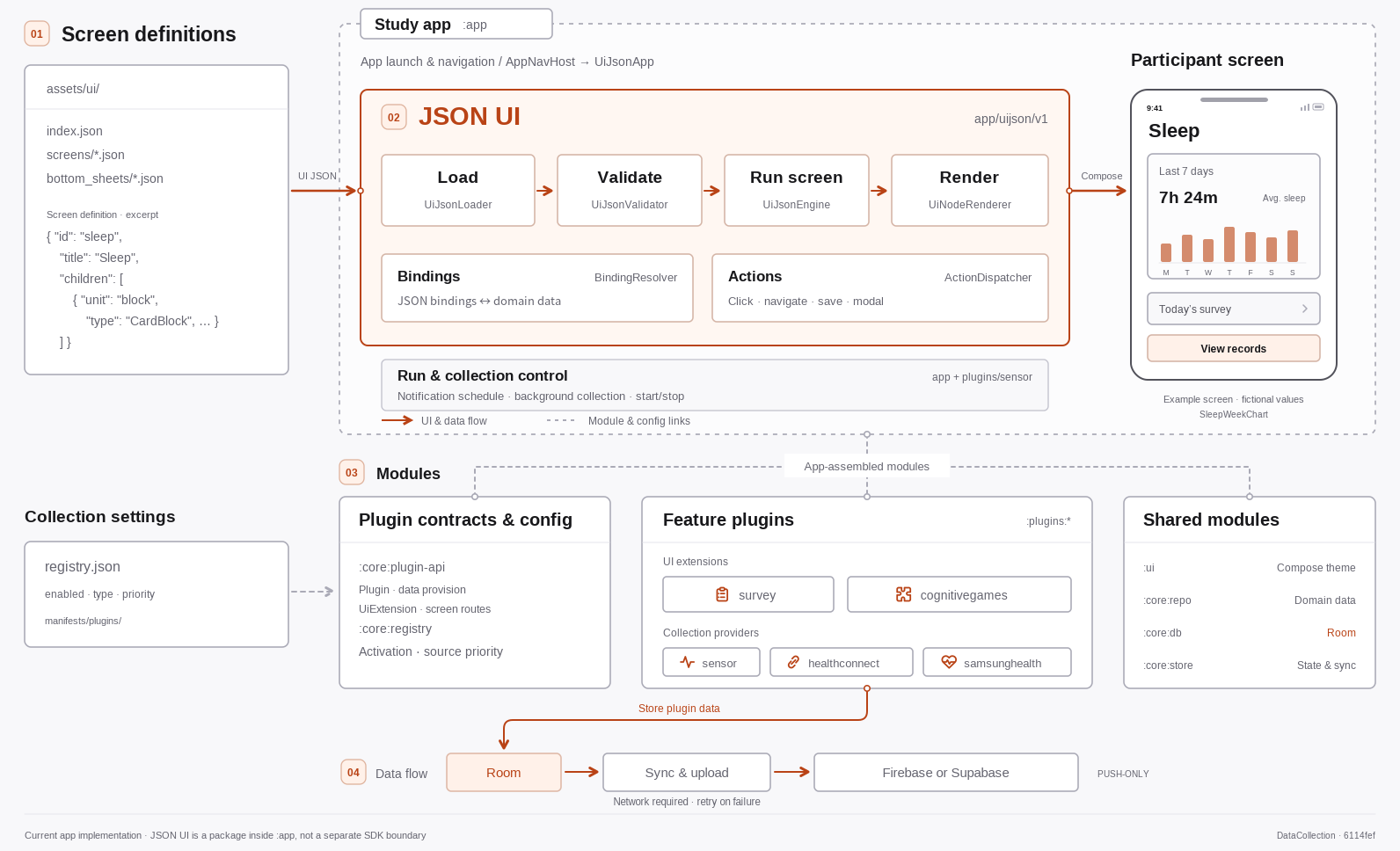
Read the diagram
Screen JSON is loaded, validated, run and rendered inside :app. BindingResolver connects JSON bindings to domain data, and ActionDispatcher handles clicks, navigation, saves and modals.
Plugin provides data; UiExtension registers screen routes. Collection settings in registry.json control activation and source priority. The app assembles feature plugins and shared modules, including the :ui Compose theme.
The app controls notification schedules and background collection. Plugin data is stored locally in Room, then pushed to the selected Firebase or Supabase backend. Sync requires a network connection and retries failed work.
Diagram baseline: DataCollection 6114fef. Connections show app assembly, not the complete Gradle dependency graph or a separate SDK boundary. The participant screen is an example with fictional values. View implementation evidence (opens in a new tab).
Plugins connect data sources. The storage and read layers use Room as their local source of truth. Studies with server storage synchronize through the existing Firebase or Supabase data sources. Audio files have a separate storage policy from response metadata.
Reading implementation status
- Enabled by default: Selected in the baseline configuration. This does not guarantee that every device produces records.
- Implemented: A read, mapping, or storage path exists, but may not be part of default collection.
- Planned: Additional implementation or external host-app validation is required.
- Needs verification: Current evidence does not establish device support or runtime behavior.
Documentation baseline
This documentation reflects the September 17, 2026 working tree and the MD4BD meeting presentation. Research examples and future SDK plans are distinguished from the current Android runtime. Configuration examples use fictional identifiers and contain no real participant data.